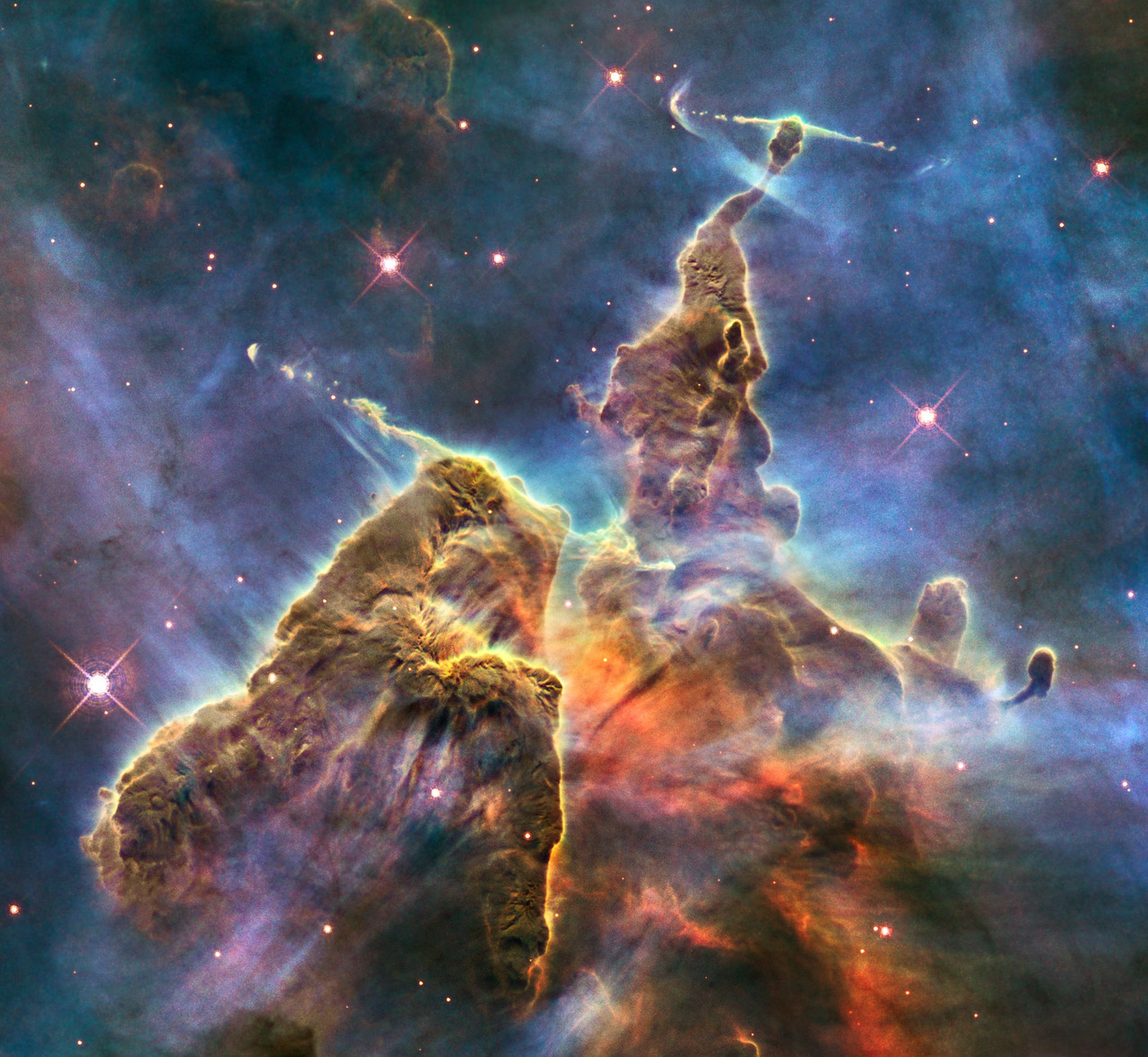
This region of the Carina Nebula is known as ‘Mystic Mountain’ - a three-light-year-tall pillar of gas and dust containing jets of gas being emitted by infant stars. source
We often talk about ideas being sparked and laying seeds for inspiration, so here is a collection of resources, seeds, and sparks for us to share. Who knows what exciting lessons, work, and discussions could come from this!
Showing posts with label Planet Earth and Beyond. Show all posts
Wednesday, 4 July 2018
Tuesday, 21 February 2017
Space Artists's Concepts for Unseen Planets
Check out npr to see the process behind designing concept art for newly discovered planets. It is fascinating!
'This artist's impression shows a best guess of what the surface of the planet
Proxima b might look like, as it orbits the red dwarf star Proxima Centauri, the
closest star to our solar system. Maybe Mars was the model?'
M. Kornmesser/ESO
Waterball Ping Pong
"Astronaut Scott Kelly has spent more time in space than any other American. He has also played solo ping pong with a ball of water and two hydrophobic paddles."
Image Credit: NASA
You MUST Watch this Video
Earth's history is laid out to scale on a football field. A VERY cool timeline.
Tuesday, 26 July 2016
Scale of the Universe
source
Thursday, 23 July 2015
Wednesday, 6 May 2015
Alejandro Duran's 'Washed Up' Sculptures
Alejandro Duran has created sculptures out of trash to raise awareness of environmental issues relating to Sian Ka'an in Mexico.
He identified trash from 50 different countries (from 6 continents) that had washed up at the Sian Ka'an reserve and began to create his photographs.
He won the 2015 Project Launch Juror's Award for Washed Up.
More photos from Washed Up can be found at http://www.mymodernmet.com/profiles/blogs/trash-based-photo-series-mirrors-environment-issues
Saturday, 28 February 2015
Backlit Saturn
The Cassini spacecraft was sent by NASA and ESA to study Saturn and its moons. Two of Saturn’s moons, Enceladus and Tethys, appear in the bottom right of this image. So far, the spacecraft has found new storm systems on Saturn, active geysers on its moon Enceladus, liquid oceans on its moon Titan, and many other unexpected discoveries. Due to its elliptical orbit, Cassini is occasionally able to catch beautiful images of saturn backlit by our sun, as seen above.
Credit: NASA/JPL/ESA and astronomicalwonders
Wednesday, 25 February 2015
Earthlight
Subscribe to:
Comments (Atom)


