Wednesday, 25 July 2018

Roller Coaster Physics
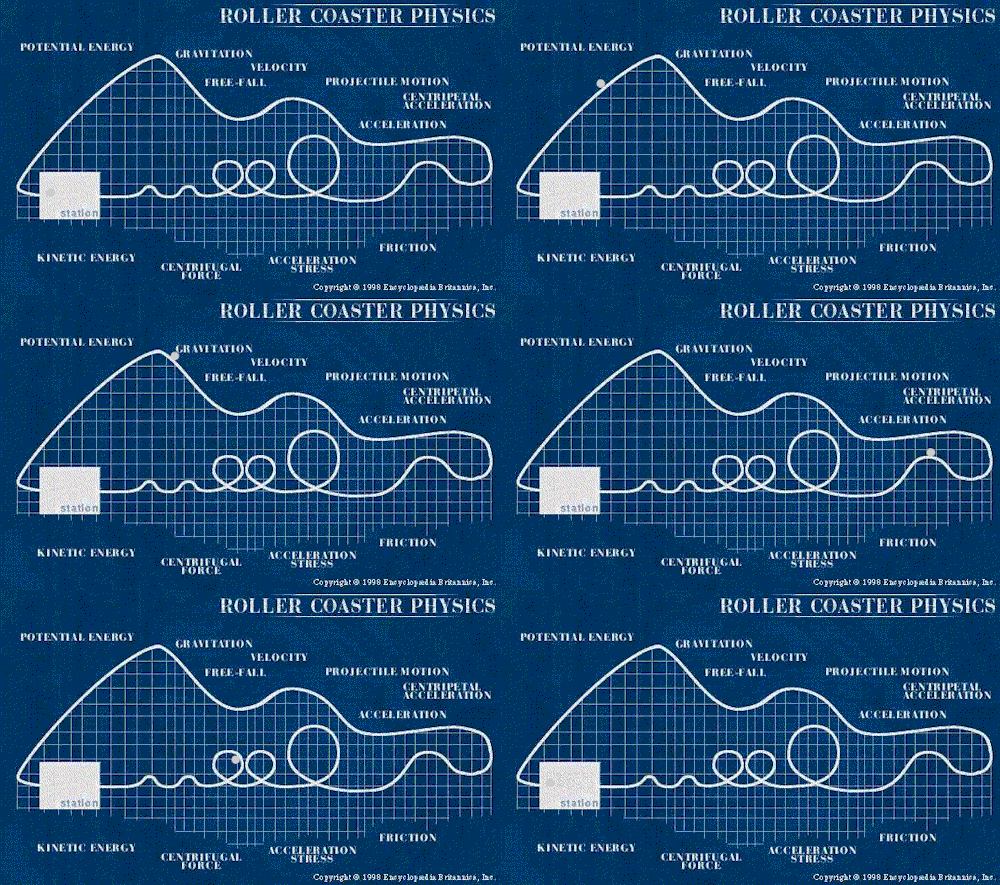
Roller Coaster Physics.
The principle that underlies the working of a roller coaster is simple. As you ascent to the top, your potential energy builds up. ( i.e the higher you go, longer the distance that the force of gravity can act upon)
This built up Potential energy gets released as kinetic energy downhill. ( Kinetic energy is the energy of motion- linear and rotational).
Now what Roller Coaster Engineers do is abuse this principle to engineering perfection.
Fly Mobius Strip
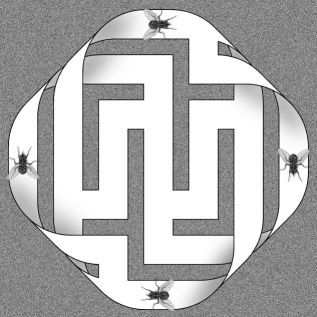
Mobius Fly Maze
Courtesy of David Phillips
"Find the path that the four flies take if they all travel the same route without meeting, and without retracing their path until they reach their original position. Keep track of which side of the path you are on."
Courtesy of David Phillips
"Find the path that the four flies take if they all travel the same route without meeting, and without retracing their path until they reach their original position. Keep track of which side of the path you are on."
This is an example of a Mobius Strip, where a surface has only one side and one boundary. It is mathematically 'unorientable'.


Can You Flatten a Sphere?
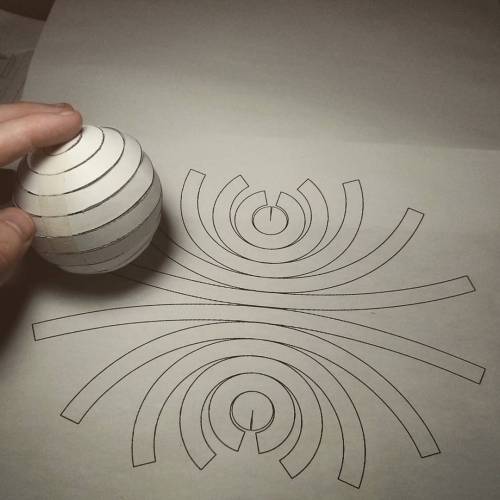
Can you flatten a sphere?
The answer is NO, you can not. This is why all map projections are innacurate and distorted, requiring some form of compromise between how accurate the angles, distances and areas in a globe are represented.
This is all due to Gauss’s Theorema Egregium, which dictates that you can only bend surfaces without distortion/stretching if you don’t change their Gaussian curvature.
The Gaussian curvature is an intrinsic and important property of a surface. Planes, cylinders and cones all have zero Gaussian curvature, and this is why you can make a tube or a party hat out of a flat piece of paper. A sphere has a positive Gaussian curvature, and a saddle shape has a negative one, so you cannot make those starting out with something flat.
If you like pizza then you are probably intimately familiar with this theorem. That universal trick of bending a pizza slice so it stiffens up is a direct result of the theorem, as the bend forces the other direction to stay flat as to maintain zero Gaussian curvature on the slice. Here’s a Numberphile video explaining it in more detail.
However, there are several ways to approximate a sphere as a collection of shapes you can flatten. For instance, you can project the surface of the sphere onto an icosahedron, a solid with 20 equal triangular faces, giving you what it is called the Dymaxion projection.

The Dymaxion map projection.
The problem with this technique is that you still have a sphere approximated by flat shapes, and not curved ones.
One of the earliest proofs of the surface area of the sphere (4πr2) came from the great Greek mathematician Archimedes. He realized that he could approximate the surface of the sphere arbitrarily close by stacks of truncated cones. The animation below shows this construction.

The great thing about cones is that not only they are curved surfaces, they also have zero curvature! This means we can flatten each of those conical strips onto a flat sheet of paper, which will then be a good approximation of a sphere.
So what does this flattened sphere approximated by conical strips look like? Check the image below.

But this is not the only way to distribute the strips. We could also align them by a corner, like this:

All of this is not exactly new, of course. In the limit, what you have is called a American polyconic projection, which does require stretching in order to fill the gaps between the ending of the strips. Gauss’s Theorema Egregium demands this.
But I never saw anyone assembling one of these polyconic approximations. I wanted to try it out with paper, and that photo above is the result.
It’s really hard to put together and it doesn’t hold itself up too well, but it’s a nice little reminder that math works after all!
Wednesday, 4 July 2018
Mystic Mountain
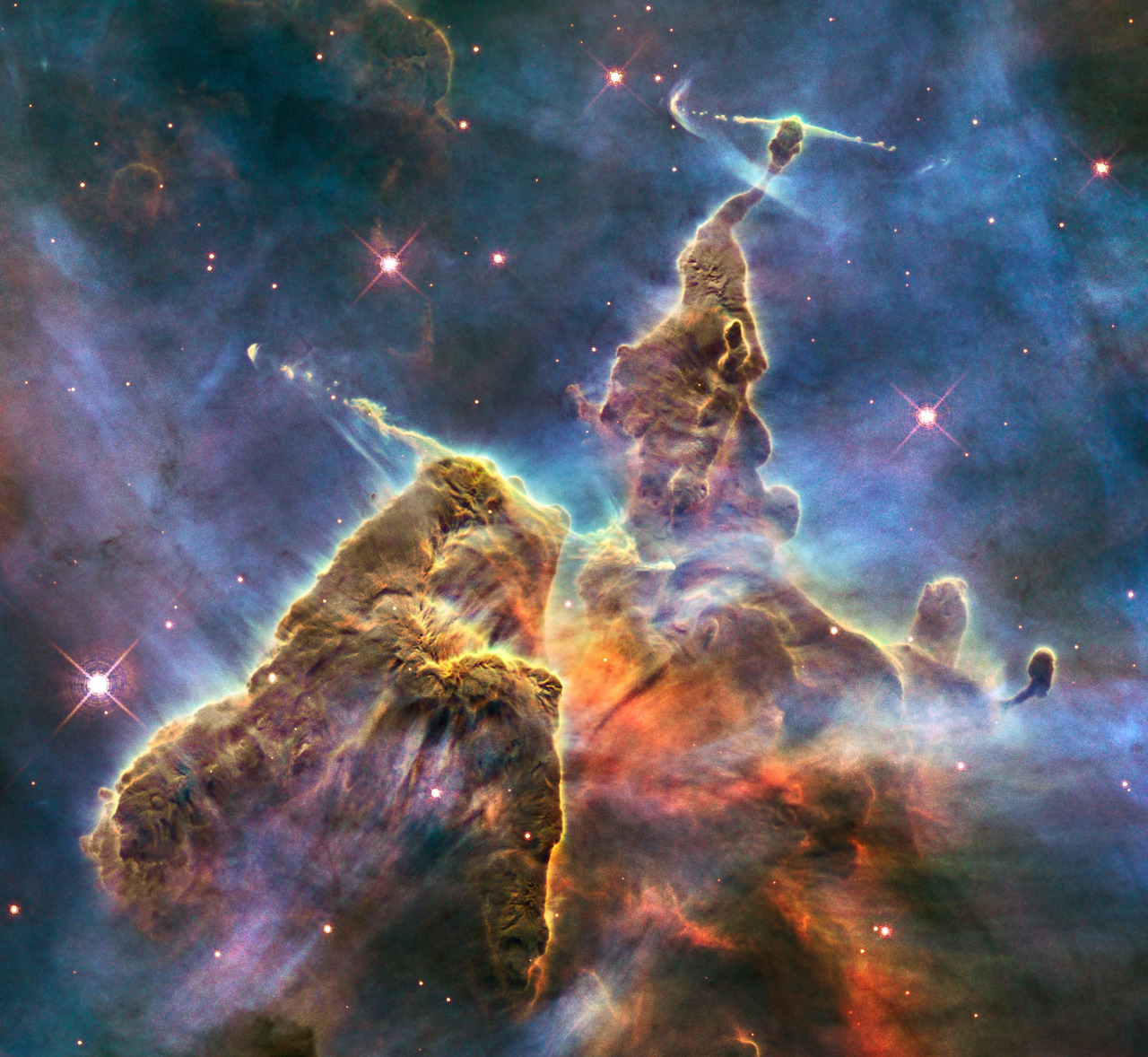
This region of the Carina Nebula is known as ‘Mystic Mountain’ - a three-light-year-tall pillar of gas and dust containing jets of gas being emitted by infant stars. source
Tuesday, 21 February 2017
Space Artists's Concepts for Unseen Planets
Check out npr to see the process behind designing concept art for newly discovered planets. It is fascinating!


M. Kornmesser/ESO
Waterball Ping Pong
"Astronaut Scott Kelly has spent more time in space than any other American. He has also played solo ping pong with a ball of water and two hydrophobic paddles."
Image Credit: NASA


You MUST Watch this Video
Earth's history is laid out to scale on a football field. A VERY cool timeline.
Giant Creatures


Full story here. And here’s our rhyming round-up of other ancient, giant versions of modern mammals:


Where in the World Have New Diseases Emerged?

"What new viruses are emerging in your backyard?
If you’re a germaphobe, make sure you’re sitting down.Back in 1999, a woman in California cleaned up rodent droppings in her home. Two weeks later, her liver started failing. Then she started to bleed internally — a hemorrhagic fever that would kill her. Eventually doctors found a new virus in her body, which very likely came from a rat.A few years later, a man in Arizona went to the hospital. The skin on his legs was infected and dying. Doctors had to amputate. His diagnosis? A new kind of leprosy.Over in the Midwest, the problem has been new tick-borne diseases, some deadly. And in New England, doctors are dealing with a disease that causes Lyme-like symptoms but is caused by a different bacteria.The pattern continues across the country and across the world. A spike in new infectious diseases is the new normal.
Another side effect of humanity’s conquest of the natural world."
Frog Spit is a Non-Newtonian Fluid


"The researchers used high-speed photography and an instrument called a Rheometer to analyze frog saliva under prey-capturing conditions. The scientists think frog tongues could one day help engineers design reversible soft adhesives that could work at high speeds.
Read more about it here."
Dye that Changes Colour Like a Moodring
"Color-changing hair might seem like something out of a fantasy novel, but Lauren Bowker of The Unseen has made it a reality. Bowker, a chemist and fashion designer, is known for her “high-fashion alchemy.” She’s previously created hue-shifting purses as well as other air sculptures that use science to produce a stunning visual effect. Now, she’s turning her attention towards color-changing hair dye that’s controlled by temperature—when there’s a dramatic spike or drop, the dye seemingly has a mind of its own... Each hue reacts to either bodily or environmental temperatures. Blushing, for instance, causes your body temperature to rise and as a result, a shift in color... Weather is also a factor. With one color combination, stepping into chilly weather shifts blonde hair to a fitting icy blue."


Thursday, 1 September 2016


Tuesday, 2 August 2016
Roald Dahl Science
Emma Vanstone has collected different science activities (apropriate for junior students and possible to adapt for older students) that relate to Roald Dahl and his books.
http://www.science-sparks.com/2015/09/11/roald-dahl-activity-ideas/
http://www.science-sparks.com/2015/09/11/roald-dahl-activity-ideas/
Tuesday, 26 July 2016
Scale of the Universe
source
Conductive Silver Ink Pen
source
Subscribe to:
Posts (Atom)